ОГЛЯД: Екологічна безпека жінок та чоловіків у контексті війни росії проти України

Цей Огляд присвячений екологічній безпеці жінок і чоловіків в Україні в умовах війни росії проти України, зміни клімату, руйнування інфраструктури, забруднення довкілля та відновлення громад. Документ виходить із того, що екологічні та кліматичні кризи не є нейтральними: вони по-різному впливають на жінок і чоловіків, дівчат і хлопців, людей різного віку, мешканок і мешканців міст, сіл, прифронтових, деокупованих і приймаючих громад. Рівень вразливості залежить від місця проживання, стану здоров’я, інвалідності, віку, доходу, статусу внутрішньо переміщеної особи, доступу до води, енергії, транспорту, медичних і соціальних послуг, а також від розподілу оплачуваної й неоплачуваної доглядової праці.

Документ

REVIEW: Environmental Security of Women and Men in the Context of Russia’s War Against Ukraine (Full Version)

This Review is dedicated to the environmental security of women and men in Ukraine in the context of Russia’s war against Ukraine, climate change, infrastructure destruction, environmental pollution and community recovery. The document proceeds from the understanding that environmental and climate crises are not neutral: they affect women and men, girls and boys, people of different ages, and residents of urban, rural, frontline, de-occupied and host communities in different ways. Levels of vulnerability depend on place of residence, health status, disability, age, income, internally displaced person status, access to water, energy, transport, health and social services, and the distribution of paid and unpaid care work.

Document (full version)

Environmental Security of Women and Men in the Context of Russia’s War against Ukraine (Short Version)

Environmental Security of Women and Men in the Context of Russia’s War against Ukraine (Short English Version)

This Review proceeds from the understanding that all regions of Ukraine are facing a combined crisis: existing environmental problems and the effects of climate change are intensified by the destructive impact of the war. The Review focuses on environmental security through the experience of women from urban and rural communities, civil society organizations, local self-government, state institutions, expert communities, activist groups, and local initiatives.

The purpose of the Review is to map organizations, institutions, laws, policies, action plans, and initiatives related to the Triple Nexus in Ukraine, assess vulnerability to climate change, and develop a specialized roadmap. Within this purpose, the Review analyzes how environmental and climate risks, intensified by the war, affect women, men, and different population groups; assesses whether international and national policies and practical measures take these differences into account; and identifies key gaps and recommendations for state authorities, local self-government, civil society, and international organizations.

Document

Потрійний зв’язок у гуманітарному реагуванні, розвитку та миробудуванні для ефективнішої реалізації Резолюції РБ ООН «Жінки, мир та безпека» в Україні

Дослідження є первинним аналітичним оглядом застосування підходу Потрійного зв’язку в Україні – поєднання гуманітарного реагування, сталого розвитку та миробудування – у контексті триваючої збройної агресії Російської Федерації та реалізації порядку денного «Жінки, мир, безпека». Український контекст вимагає одночасного застосування цього підходу: громади реагують на наслідки обстрілів, приймають внутрішньо переміщених осіб, підтримують родини військових і загиблих, забезпечують соціальні послуги, інтегрують ветеранів і ветеранок, відновлюють інфраструктуру, реагують на насильство за ознакою статі та працюють із соціальною напругою.

Документ

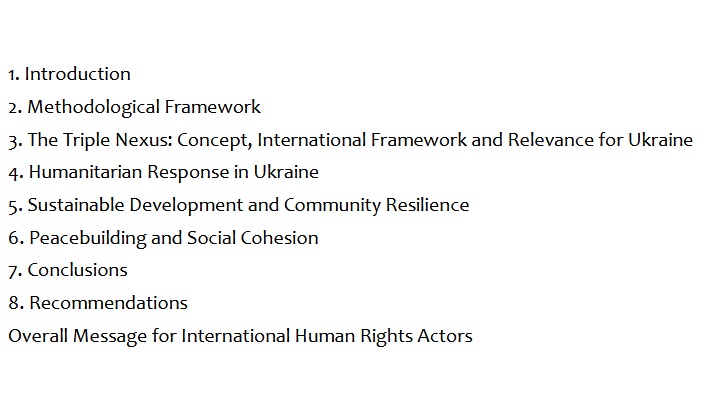
Executive Summary – The Triple Nexus in Humanitarian Response, Development and Peacebuilding for More Effective Implementation of the Women, Peace and Security Agenda in Ukraine

This report provides a first analytical overview of how the Triple Nexus approach – the connection between humanitarian response, sustainable development and peacebuilding – can be applied in Ukraine in the context of Russia’s ongoing armed aggression and the implementation of the Women, Peace and Security (WPS) agenda. It examines how existing Ukrainian laws, policies, institutions, local practices and civil society initiatives already contain important elements of the Triple Nexus, while also identifying the gaps that prevent these elements from working as one coherent system.

document

Програма Молодіжного клубу правосуддя

В умовах триваючої збройної агресії проти України особливого значення набуває формування у молоді розуміння прав людини і прав дитини, принципів верховенства права та відповідальності за воєнні злочини, а також розвиток критичного мислення і навичок безпечної роботи з інформацією.

З метою розвитку цих компетентностей у межах проєкту «Справедливість для української молоді: розслідування та переслідування воєнних злочинів російської федерації проти українських дітей», який реалізується у 2024–2026 роках за підтримки Відділу з правоохоронних питань (INL) Посольства США в Україні та адмініструється міжнародною організацією PH International (Project Harmony, Inc.), у партнерстві з українськими громадськими організаціями – Всеукраїнською громадською організацією – Центр «Розвиток демократії» та громадською організацією «Придунайський центр громадських ініціатив», а також профільними державними інституціями – Департаментом з питань захисту інтересів дітей та протидії домашньому насильству Офісу Генерального прокурора України та Управлінням ювенальної превенції Національної поліції України – створено та функціонують Молодіжні клуби правосуддя.

Клуби діють у п’яти містах України: Бучі, Болграді, Кропивницькому, Луцьку та Львові. У період з вересня 2024 року по травень 2026 року в їхній роботі беруть участь понад 150 дітей віком 13–18 років, які залучені до системних щотижневих позашкільних занять.

Заняття побудовані за принципом поступового формування знань: спочатку учасники знайомляться з основними правами дитини та системою їх захисту, після чого переходять до теми воєнних злочинів російської федерації проти українських дітей і механізмів їх розслідування та притягнення до відповідальності. Навчання відбувається у практичному форматі, наближеному до реальних правових ситуацій: учасники працюють з кейсами, беруть участь у моделюванні судових процесів та виконують завдання з використанням OSINT-методів.

Паралельно в межах проєкту проводяться інформаційні семінари-дискусії для фахівців у сферах кримінального права, охорони здоров’я, освіти, соціальної роботи та громадянського суспільства. Тематика семінарів охоплює стандарти забезпечення конфіденційності та недопущення розголошення інформації щодо дітей, які стали свідками або постраждали від воєнних злочинів, а також застосування методів розслідування на основі відкритих джерел (OSINT / Open Source Intelligence) для формування та аналізу доказової бази.

За результатами узагальнення практичного досвіду реалізації проєкту та з метою систематизації й масштабування напрацьованих підходів розроблено навчальну програму обсягом 85 занять (170 годин). Програма є підсумковим продуктом проєкту та після його завершення буде використовуватися ВГО – Центр «Розвиток демократії» у подальшій роботі з дітьми та молоддю з питань документування, розслідування та притягнення до відповідальності за воєнні злочини російської федерації проти українських дітей.

Програма опублікована за посиланням.

Готується спільне подання, присвячене впливу війни, політики жорсткої економії та процесів відновлення на оплачувану й неоплачувану доглядову працю жінок та реалізацію економічних, соціальних і культурних прав в Україні


Центр соціальних і трудових досліджень (CSLR) разом із партнерами та учасницями проєкту «Caring to Survive, Surviving to Care» готує спільне подання до 54-ї сесії Робочої групи Універсального періодичного огляду (УПО) України.
Назва документа, також підтриманого НУО ЦРД:
«Surviving to Care: Women’s Unpaid and Paid Care Labour in Wartime Ukraine»
Подання присвячене впливу війни, політики жорсткої економії та процесів відновлення на оплачувану й неоплачувану доглядову працю жінок та реалізацію економічних, соціальних і культурних прав в Україні.
Організатори запрошують до співпідписання українські громадські організації, профспілки, жіночі організації, академічні інституції, місцеві ініціативи та окремих експерток і експертів, які працюють у сферах:
– гендерної рівності та прав жінок;
– соціальної політики та доглядової праці;
– трудових прав;
– підтримки ветеранів і ветеранок;
– прав людей з інвалідністю;
– захисту прав ВПО;
– психічного здоров’я;
– освіти та охорони здоров’я;
– розвитку сільських громад;
– відновлення та реконструкції України.
Кінцевий термін подання інформації для включення до списку співпідписантів:
15 липня 2026 року (23:59 за київським часом).
Просимо заповнити форму:
ПОСИЛАННЯ НА GOOGLE FORM
Текст проєкту подання доступний за посиланням:
ПОСИЛАННЯ НА ДРАФТ ДОКУМЕНТА

Група держав в ООН запускає політичну декларацію глобального мораторію на сурогатне материнство

Група країн в ООН на чолі із Італією та Чилі запускає політичну декларацію глобального мораторію щодо практики сурогатного материнства. Про це повідомляє europeanconservative.

Важливий перший крок для майбутніх масштабних змін, як сподіваються ініціатори, був представлений 22 червня 2026 року під час роботи 62-ї сесії Ради прав людини ООН.

Документ не є офіційною зміною, жодна держава не змушена змінювати свої внутрішні закони. Однак ця декларація виводить практику сурогатного материнства до міжнародного порядку денного прав людини – зі сфери приватних відносин до транснаціональної практики, що зачіпає питання батьківства, прав дитини, експлуатації, створює серйозні ризики для жінок і дівчат, юридичну невизначеність для народжених дітей, стимулює трафікінг, медичну шкоду.

Національного регулювання для проблеми такого масштабу недостатньо, стверджують ініціатори декларації: цей “ринок” є глобальним, таким має бути і реагування на порушення.

UN States Launch Political Declaration for Global Surrogacy Moratorium

A group of states at the United Nations has launched a political declaration calling for an international moratorium on surrogacy, marking a significant first step in what its supporters hope will become a global abolitionist framework – europeanconservative.

The declaration, spearheaded by Italy and Chile, was presented on June 22 on the sidelines of the 62nd session of the UN Human Rights Council. It was co-hosted by Italy, Chile, Cameroon, and the Holy See, with ADF International moderating the event.

The document is not binding. No state is legally compelled to change its domestic law because of it. But in diplomatic terms, the move really matters: it places surrogacy on the international human rights agenda not as a private contractual arrangement but as a transnational practice raising questions of exploitation, commodification, parentage, nationality, and the rights of children.

The declaration calls for an international moratorium on surrogacy as a step towards a legally binding international instrument. It argues that the practice involves serious risks for women and children, including medical harm, coercion, loss of agency, psychological consequences, identity-related problems, legal uncertainty, abandonment, trafficking, and exploitation.

For its promoters, the central point is that national regulation is no longer enough. Surrogacy has become a cross-border market. Countries with restrictive laws can still export demand to jurisdictions where women are poorer, legal protections are weaker, and intermediaries are more aggressive.

That contradiction is particularly visible in Europe. Italy became the first country to prohibit surrogacy both within and outside its borders, while Slovakia has moved to entrench a ban at the constitutional level. Other major European countries, including France, Germany, and Spain, maintain restrictive approaches in domestic law. Yet the absence of a common international framework allows agencies, clinics, and commissioning adults to move the transaction elsewhere. The practice disappears from the national territory, but not from the market. It is outsourced.

Giorgio Mazzoli, Director of UN Advocacy at ADF International, told europeanconservative.com that the declaration is important because it helps align states around the “urgent need for coordinated action.”

“The reality is that this industry is expanding exponentially,” Mazzoli said, warning that it is “preying on countries” where women are economically vulnerable or where the absence of an express prohibition allows companies and advertisers to operate in legal grey zones.

He argued that the debate has shifted because evidence of harm has become harder to ignore. “We are talking about psychological and maternal health-related implications but also about children, their early development and long-term wellbeing,” he said.

“Women cannot consent to their own exploitation,” Mazzoli said, adding that this is not merely a moral claim but one supported by international human rights law.

The declaration follows the work of Reem Alsalem, UN Special Rapporteur on violence against women and girls, whose 2025 report described surrogacy as a form of exploitation and violence against women and children. Talking to europeanconservative.com, Alsalem said the new state-led initiative shows that “the international conversation on surrogacy has entered a new phase.”

“My report demonstrated that the harms intrinsic in surrogacy cannot be addressed by regulation alone and are not limited to commercial arrangements,” Alsalem said. She backed the call for a moratorium as “an initial step towards the abolitionist model,” while stressing that abolition and criminalisation are not the same.

That distinction is politically important. Alsalem supports an approach that targets those who create or profit from demand—commissioning adults, brokers, agencies, and clinics—while treating surrogate mothers as victims entitled to protection, remedies, legal aid, psychosocial support, and economic alternatives.

The legal obstacles are well-known. States have different frameworks: some prohibit surrogacy, others allow so-called altruistic arrangements, others regulate commercial markets, and many leave grey areas. That fragmentation allows what Alsalem described as “forum shopping” across jurisdictions.

Mazzoli said the next stage is to bring more states into the declaration. “This is an open document. It does not end here,” he said. The goal, he added, remains a binding international instrument, but the process will require intermediate steps: more evidence, national legislative changes, political momentum, and a clearer shared understanding of what surrogacy does to women and children.

In practical terms, the process is still at an early stage. First comes a non-binding political declaration. Then, more states may sign on. After that, governments can use the text to revise national laws, close loopholes, and build diplomatic support. Only once a sufficient coalition exists could negotiations begin on a binding treaty or convention.

That is a long road. But for those who oppose the buying and selling of babies and the exploitation of women, the fact that states have now placed the issue formally on the UN track is already the point: the market is global, and the response is beginning to become global, too.

Javier Villamor is a Spanish journalist and analyst. Based in Brussels, he covers NATO and EU affairs at europeanconservative.com. Javier has over 17 years of experience in international politics, defense, and security. He also works as a consultant providing strategic insights into global affairs and geopolitical dynamics.

Громадські організації просять структури ЄС продовжити захист для українських жінок і дітей після 4 березня 2027

Громадські організації підписуються під закликом до структур Європейського Союзу продовжити тимчасовий захист або перевести в іншу форму захисту українських жінок і дітей, котрі виїхали до країн ЄС, та застосувати дії для цього до 04 березня 2026 року.

До підписантів долучились і в НУО Центр “Розвиток демократії”.

Підписатись під ініціативою можна за посиланням.