

Презентація до вебінару «Проституція як насильство проти жінок і кращі світові практики протидії», авторка Дріша Фернандес
Категорія: Матеріали
Міжнародні норми щодо проституції та зобов’язання України

Презентація до вебінару «Проституція як насильство проти жінок і кращі світові практики протидії», авторка Олена Зайцева
файл за посиланням
Сурогатне материнство, хижацька система щодо вразливих жінок

Презентація до вебінару “Сурогатне виношування: етичні виклики”, авторка Марі-Жозеф Девільє
Шкода сурогатного материнства для жінок та дітей в Індії

Презентація для вебінару “Сурогатне виношування: етичні виклики”, авторка докторка Шила Сурьянараянан.
файл за посиланням
Impact Verified Seal

Share your Impact Verified Seal in your signature file, on your website,
and include it in your annual impact report.
NGOs alternative statement regarding the B+30 progress implementation in the region UNECE
Referring to the Resolution adopted by the General Assembly on 23 February 2023 # ES-11/6. Principles of the Charter of the United Nations underlying a comprehensive, just, and lasting peace in Ukraine and United Nations General Assembly Resolution 68/262 adopted on 27 March 2014 by the sixty-eighth session of the United Nations General Assembly in response to the Russian annexation of Crimea and entitled “territorial integrity of Ukraine.”
Referring to the stated point in the UNSCR 1325 that peace and stability are the preconditions for implementing the Women’s Peace and Security Agenda (UNSC res/1325-2000).
The NGOs from Ukraine and other countries of the UNECE region made this statement as follow of the Beijing+30 Regional Review Meeting, titled “Reviewing 30 years of Beijing Commitments to Accelerate Gender Equality in the UNECE Region,” on October 21-22, 2024, in Geneva, Switzerland.
We must underline that the UNECE region has been suffering from wars since 2008 (Georgia), 2014 – ongoing Russian aggression against Ukraine, war affects Lebanon and Syria. All these actions caused massive ways of refugees to the European countries and increased the political power of the radical voices calling for the limitation of human rights in host countries. The hybrid wars affect the rights of women in many countries of the region. Examples of their effect are the limitation of activities of the CSOs (adoption of the law on foreign agents in Kyrgyzstan and the Government’s force to do this in Georgia, which will limit the work of the women’s CSOs), political violence against women candidates (brutal propaganda campaigns against President of Moldova Maria Sandu who support the integration of Moldova to the EU, which necessitates reforms to ensure the high level of access to justice and human rights protection).
The above-mentioned examples demonstrate the creation of barriers for women to participate in civil society and political processes, and women’s organizations struggle to find resources. This remains the case despite ample evidence existing that women’s participation contributes to more robust democracies and longer-lasting peace, as stated in the UNSCR 1325 and BPfA (Section E).
Russia employs human torture in illegal detention, cruel, inhuman, and degrading treatment, summary and arbitrary executions, and disappearances of children. The country’s aggressor kidnapped twenty thousand Ukrainian children, human rights activists and journalists are especially vulnerable to arbitrary detentions. Thirty Ukrainian journalists are still in Russian prisons, and seven women journalists were killed doing their professional jobs, like Victoria Amelina, who documented CRSV, and Victoria Roschyna, who was tortured in illegal Russian captivity.
We must deplore the dire human rights and humanitarian consequences of the aggression by the Russian Federation against Ukraine, including the continuous attacks against critical infrastructure across Ukraine with devastating consequences for civilians, and express grave concern at the high number of civilian casualties, including women and children, the number of internally displaced persons and refugees in need of humanitarian assistance, and violations and abuses committed against children. The attacks on the energy system of Ukraine and the occupation of the Chornobyl and Zaporizhzhya nuclear stations are severe threats to nuclear insecurity in the European region. In its 2016 Preliminary Examination Report, the International Criminal Court reported sexual and gender-based crimes committed against civilian men and women in the temporarily occupied territories of Ukraine. As of September 2024, the Office of the General Prosecutor of Ukraine has investigated 342 CRSV cases committed by Russian combatants.
Russian occupation of Crimea has affected the rights of the indigenous people of Crimea, Crimean Tatars. Hundreds of thousands of Crimean Tatars were forced to change their citizenship, thousands were imprisoned and suffered from xenophobia, religious intolerance in temporarily occupied Crimea, denials of economic, social and cultural rights. Women Crimean Tatars suffer from overburden of care work for their families as their husbands are in prisons as political prisoners.
The mental and physical health of Ukrainian civilians, women, girls, elderly, and disabled people are suffering every day from missile and Shahed drone attacks. Young Ukrainians are captured in Russian captivity, like Yulia Sokolova, who was imprisoned by Russia in the occupied Ukrainian city of Skadovsk when she was 16 years old. She is a civilian girl who, according to the Geneva Conventions, could not be taken captive in Russia. She has been in a Russian prison in temporarily occupied Crimea for three years.
The war against Ukraine has changed the women’s and feminist movement in Ukraine, but it’s not stopping it. Ukrainian women activists who try to find Activism – Work – War – Life balance are working for advocacy of women’s rights at the local, national, and global levels, defending the rights of women with disabilities, LBTQI women, and rural and Roma women and supporting them amid new challenges brought by the war.
It is impossible to start peacebuilding initiatives during the most brutal and massive war in Europe since the Second World War. Russia’s invasion of Ukraine continues to inflict a devastating toll on Ukraine and countries of the region UNECE. It is causing severe global repercussions, including terrorist movements and the adverse impact of the war on global food security, energy, nuclear security and safety, and the environment.
The regional women’s movement must unite for international advocacy to support Ukraine and other countries suffering from the wars.
We call on the feminists and representatives of the national gender equality machinery to act and fight for peace instead of talking about peacebuilding with aggressors.
We can’t talk about peacebuilding before the sovereignty of Ukraine is renewed according to the internationally recognized borders. Survivors of war crimes have to receive fair and long-term reparations, especially those who survived the CRSV. We urge the international community to support justice for survivors and hold Russia accountable for its crimes.
We believe that the global meeting to review progress in the implementation of the Beijing Platform for Action in March 2025 should seriously pay attention to the destruction of security in the UNECE region and human rights violations caused by the war of the Russian Federation against Ukraine. In our opinion, politically neutral language such as “conflict and geopolitical tension in the region,” which was used in the concept of the regional meeting, some speeches of participants, and the final NGO statement, does not correspond to the definition of the essence of Russia’s actions against Ukraine and UN General Assembly Resolutions underlying a comprehensive, just, and lasting peace in Ukraine. The Global meeting should pay attention to analysis of the harms and violation of women’s rights in the UNECE region and the condemnation of the corresponding actions of the aggressor country. The WPS should be mainstreamed to analysis of implementation of all Beijing Platforms chapters.
We ask the feminist movement to not give up and advocate the governments to continue supporting Ukraine. Steadfast support for Ukraine and its victory is the best implementation of the Beijing Platform of Action and prevents wars in other countries.
Rephrasing the Vienna Conference principle, we ask for “nothing about war-affected countries without these countries and women’s CSOs from these countries.”
We ask to push Russia to release the Ukrainian journalists and human rights defenders, civilians from captivity and stop shelling Ukraine.
We ask for an honest and inclusive discussion about the threats to women’s rights implementation stated above and to collaborate on developing strategies to respond to them.
We ask to integrate the analysis of the impact of Russian aggression against Ukraine and its support of anti-democratic governments into the consolidated regional inputs for the 69th session of the Commission on the Status of Women.
Reform the UN to take effective action to stop wars, as the number of them has increased since Beijing + 25. The number of wars and their scale prove that the system doesn’t work efficiently.
Signed NGOs representatives and number of independent gender experts and human rights, young feminist activists representatives ABC order
| Alliance Political Action for Women | Ukraine | |
| Bila Tserkva Charitable Foundation “Zamkova Gora” | Ukraine | |
| Board of the All-Ukrainian Public Union of Women | Ukraine | |
| Center for women who suffered from domestic violence “Faith, Hope, Love” | Ukraine | |
| Center of Social Services | Ukraine | |
| Centre for social & gender research “New Life” | Ukraine | |
| Charity fund “Misto Tysiachi Dzherel” | Ukraine | |
| Charity Organization Family | Ukraine | |
| Civic Council for the Parliamentary Gender Caucus “Equal Opportunities” | Ukraine | |
| Civic Council of the Parliamentary Gender Caucus Equal Opportunities | Ukraine | |
| CO CF Thrive | Ukraine | |
| Coalition 1325 Odesa Region | Ukraine | |
| Expert Resource Gender in Detail | Ukraine | |
| CSO “La Strada-Ukraine” | Ukraine | |
| CSO “Heart in Palms” | Ukraine | |
| CSO “Independent Women” | Ukraine | |
| CSO “People with Disabilities in Future” | Ukraine | |
| CSO “Positive Women. Odesa” | Ukraine | |
| CSO “Positive Women” | Ukraine | |
| CSO “Union of Multi-child families with low-income and single mothers, “Nadia” | Ukraine | |
| CSO Center of Civic Activity Synergy | Ukraine | |
| CSO Enpud | Ukraine | |
| CSO Liberal Society Institute | Ukraine | |
| Cultural and educational space “Honcharenko Center” | Ukraine | |
| Democracy Development Center | Ukraine | |
| Gender Museum | Ukraine | |
| Women’s Informative Consulting Center | Ukraine | |
| Health Right Ukraine | Ukraine | |
| Kyiv School of Equal Opportunities | Ukraine | |
| National Council of Women of Ukraine | Ukraine | |
| National Union of Journalists of Ukraine | Ukraine | |
| New Life Charitable Foundation | Ukraine | |
| NGO “Age of Possibility” | Ukraine | |
| NGO “Bureau of Gender Strategies and Budgeting” | Ukraine | |
| NGO “Council of Women Farmers” | Ukraine | |
| NGO “Culture of Democracy” | Ukraine | |
| NGO “Open Society” | Ukraine | |
| NGO “Special workshop — Art for autism” | Ukraine | |
| NGO “Territory of Woman” | Ukraine | |
| NGO “Woman of the Future” | Ukraine | |
| NGO “Women’s Union of Solomyan District of Kyiv” | Ukraine | |
| NGO “Culture of democracy” | Ukraine | |
| NGO “EdCamp Ukraine” | Ukraine | |
| NGO GIRLS | Ukraine | |
| NGO Institute of gender programs | Ukraine | |
| NGO Pislyazavtra | Ukraine | |
| NGO Podilsky Center Gender Consultative Center | Ukraine | |
| NGO Rural Women Business Network | Ukraine | |
| NGO Women’s Center “Support, protection and care” | Ukraine | |
| Non-Governmental Organization “Women Association Sphere (Kharkiv)” | Ukraine | |
| NGO “League of Professional Women” | Ukraine | |
| Office of Support of Families of Veterans, IDPs and Combatants (Lviv) | Ukraine | |
| Public Organization “Public Movement “Faith, Hope, Love” | Ukraine | |
| Secretariat of the Cabinet of Ministries of Ukraine | Ukraine | |
| Taras Shevchenko National University, Professor at Theory and History of Sociology Department | Ukraine | |
| Ukrainian Association for Research in Women’s History | Ukraine | |
| Ukrainian Heritage, Art and Music Centre – Ukrainian HAM in Cambridge | Ukraine | |
| Ukrainian Women Lawyers Association “JurFem” | Ukraine | |
| University of Kyiv-Mohyla Academy, Department of Sociology | Ukraine | |
| Vice Chairperson NGO “Centre of Gender Culture” | Ukraine | |
| Women in Media NGO | Ukraine | |
| Women’s Guard NGO | Ukraine | |
| Women’s Consortium of Ukraine | Ukraine | |
| Women’s Information Consultative Center | Ukraine |
Звіт про діяльність НУО ЦРД у 2016-2019 роках
Звіт про діяльність НУО “Центр – Розвиток демократії” у 2016 – 2019 роках англійською мовою – за посиланням.
What is the model of equality?
Ukraine
Prostitution policy: Prohibitionism – illegal
Persons in prostitution: 100.000
1) «Getting out of the circle of violence: the experience of prostitution survivors»
Within this event, women, who survived sexual exploitation, and social workers from different countries (Sweden, France, Canada, Ireland), which have already introduced the Equality Model, will share their experience of barriers on exiting prostitution and how social services and NGOs can help women in such situation.
2) «Equality model and law enforcement»
Within this event, police officers from different countries (Sweden, France, Canada, Israel), which have already introduced the Equality model, will share how they are working with vulnerable women and interact in this work with social services and shelters.
3) Expert discussion «Legislation and best practices to introduce the Equality Model»
Within this event, the foreign experts and parliamentarians will share their experience of working on corresponding draft laws in their countries (Sweden, France, Ireland, Canada, Latvia, the UK, Israel).
Intended audience: Ukrainian MPs, the security sector, judges, prosecutor’s office, Ministry of Social Policy, Ministry of Health Care, civil society organizations, wider public.
4) Special event for journalists “Equality Model for Ukraine: issues of coverage”
As part of this, foreign journalists will share their experience in covering the issue of sexual exploitation and information support of the Equality Model.
Intended audience: journalistic community of Ukraine, faculties of journalism of universities, intra-branch journalistic organizations of self-regulation.
youtu.be/H3JX10EDtGY
5) Expert discussion “1325 and combating conflict-related violence”
6) Expert discussion «Legislation: best practices to introduce the Equality Model»
> youtu.be/GRaI8iX8o5w
7) Competition of journalistic materials for the best coverage of the topic of the Equality Model
Starting from the first event on March 4 and until the end of April, we will accept journalistic materials for the competition.
We invite you to participate in any of these events at your convenience. The events will be held online, on the platform Zoom with recording and livestream to YouTube and Facebook. Each event is separately announced on FB and when you register you get a link to Zoom with translation.
We will also happily accept your suggestions as to experts and parliamentarians, whom we should invite to participate in these events.
The contact person and coordinator for this campaign is Democracy Development Center’s gender specialist Maria Dmytriyeva, phone / Viber / WhatsApp +38 063 100 37 51, email mdmytrieva@ddc.org.ua, who will be happy to answer all of your questions regarding this event and this campaign.
We also had the following relevant events last year (December 2020):
Sexual violence and exploitation – countermeasures facebook.com/events/371246747270606
“Women’s body is not a commodity” facebook.com/228980864124706/videos/309313676891226
Historical and legal side of prostitution in Ukraine
Not much is known about the historical context of the study of prostitution in Ukraine, because it is primarily a shadow business, so the statistics or stages of development are unidentified. It is known that in the world about 186 billion dollars are earned annually from prostitution, according to data from the European Parliament in 2014 (Sexual, 2014). Data for Ukraine vary and data on AIDS / HIV can be found more often than on the number of women involved in prostitution.
Back in 1987, prostitution was officially banned by order of the Presidium of the Verkhovna Rada of Ukraine.
The Code of Ukraine on Administrative Offenses has a separate article 181.1 – Prostitution. It states that those engaged in prostitution may receive warnings or pay a fine of 5 to 10 tax-free minimums (one tax-free minimum is equal to 17 hryvnias = 5.37 SEK) (Кодекс, 1984). This article appeared in the Code in 1987 and was supplemented later. That is, prostitution in Ukraine is subject only to the payment of an administrative fine, without criminal liability. Criminal liability for prostitution lasted from September 2001 to January 2006, and from January 12, 2006, only an administrative fine was again imposed. The pimping remained under criminal liability. And for 2020 this fine consists in payment from 85 to 170 hryvnias (26.84-53.67 SEK) and for repeated commission of an offense – from 136 to 255 hryvnias (43-80 SEK) whereas in the period from 2001 to 2006 for the same activity it was necessary to pay from 850 to 8500 hryvnias (268-2683 SEK).
Law enforcement seem to be more focused on ‘covering up’ brothels and pimps than on individual women involved into prostitution (Кива, 2020). But according to news in Ukrainian media it also happens that law enforcement or police officers blackmail and threaten women in prostitution to disclose information about them to relatives or families. For example, one of the police officers, using his official position, wanted to demand a bribe from a girl who was engaged in prostitution, so as not to reveal information about her to her family. Relatives may also threaten someone accused of prostitution, such as a father saying that he would tell everyone that his daughter had been fined prostitution if she did not leave the apartment. These are only those cases that have reached the court, but no criminal liability has been introduced for extortion. But women involved in prostitution in Ukraine could be used to expose brothels or pimps on the grounds that they will not be subject to an administrative report and their case will be rejected or closed.
There have been reports of police pretending not to noticing the existence of brothels in exchange for bribes. For example, in December 2019, police received a bribe of $ 2,000 a month for ‘covering up’ brothel owners (СБУ, 2019). Another policeman in the Odessa region demanded a bribe of $ 1,400 for hiding a brothel, for which he was detained (Поліцейський, 2019). But there are facts of detention, such as in October 2019, a brothel was exposed in Kyiv, which employed about 20 women and the pimp had an income of 70-100 thousand hryvnia per day (На Київщині, 2019). Such cases are usually difficult to detect, as they have a network of contacts and their own accountants, security guards, taxi drivers, etc.
Download
> Master Thesis Kateryna Krasnikova, 2020 – Media discourse of legalization of prostitution in Ukraine: intersectional analysis
Democracy Talks: the Swedish Model on Sex Trade Legislation
Streamed live on May 4, 2020
Countering sexual exploitation: presenting the benefits of the Swedish model
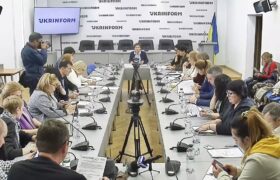
On Sep 25, 2019, a roundtable on the Nordic model of combating trafficking in human beings and prostitution was held in Kyiv, Ukraine. More than thirty representatives of state authorities and NGOs were present at the round table, broadcasting and recording provided by UKRINFORM, a state information and news agency of Ukraine.
The video is available here (in Ukrainian).
The experts explained the risks of legalization/ full decriminalization of prostitution and benefits of demand criminalization in the sex industry.
Deputy Ambassador of Sweden to Ukraine Louise Morsing stated that with the adoption of the Nordic model, fewer and fewer Swedes consider prostitution a normal behaviour. “The Nordic model is an effective counteraction to the sex industry, sexual exploitation and trafficking in human beings” she said.
According to Ms. Morsing, the law was the result of the Swedish government’s action against gender-based violence. She noted that prostitution cannot be a job, it is always exploitation and it is incompatible with internationally accepted human rights principles.
“It has been concluded that prostitution is the violence of men against women, especially against those who are economically or otherwise marginalized. This law comes from the basis of gender equality. Legally, the need to pass this law was justified by the fact that allowing men to buy women’s sex is a manifestation of gender inequality. In doing so, prostitution was acknowledged as one of the many tools used by men to oppress women and girls. In Sweden, it was concluded that it was impossible to combat human trafficking for sexual exploitation without doing anything with prostitution. Thanks to the Nordic model, we have almost no organized crime that deals with trafficking in human beings for the purpose of sexual exploitation,” Ms. Morsing said.
In turn, Yulia Dorokhova, director of the All-Ukrainian NGO “League Legalife”, believes that the official number of people involved in the sex industry in Ukraine is over 100,000, because there are too many people who do not consider themselves prostitutes, however, provide such services. She stressed that people involved in the sex industry were not aware of the benefits of a particular model of combating prostitution. Ms. Dorokhova believes that prostitution is a multigender problem. “It’s not just women and men, it’s transgender people” she said. According to Yulia Dorokhova, the main problem in the sex industry is violence. “The violence comes not only from whom they provide services, but also from the police, the state. People are not provided with medical services. The context of violence is politics of the state, traditions, religion, customs,” she noted.
Lawyer and representative of the women’s initiative Resistanta Olena Zaytseva reported that prostitution was already decriminalized in Ukraine in 2006, and now there is only administrative liability for prostitution and criminal punishment for pimping and human trafficking. Ms. Zaytseva focused attention on international and national legislation, resolutions of the European Parliament and Council of Europe. “Legalizing and decriminalizing prostitution legitimizes brothels and pimping, normalizes prostitution and the purchase of sex, and puts women and girls into higher risk of violence. Instead, the Nordic model aims to assist and rehabilitate women in prostitution, fights demand, and is a tool in the hands of the police to protect women’s rights”. The expert noted that the Council of Europe recommends the Nordic model and the European parliament does not consider decriminalisation of the sex industry a solution to keeping vulnerable women and under-age females safe from violence and exploitation. In addition, according to Ms. Zaytseva Ukraine has international commitments to address the demand in the sex industry but state does not fights demand only works with victims. Ms. Zaytseva added that one of the requirements of Ukraine’s accession to NATO will eventually be acceptance of the zero-tolerance policy regarding trafficking in human beings.
“90% of prostituted people are women. Among prostitution consumers, men make up 99%. To me, as a feminist, it’s about women’s rights,” said Maria Dmytriyeva, the moderator of Feminism UA FB group. “However, It is important to remember that this is a closed area where it is extremely difficult to conduct research”, Ms. Dmytriyeva pointed out. She noted that the average age at which girls are involved into prostitution is 14 years and the average life expectancy of women involved in prostitution is 35 years. The average number of those who have been sexually or physically abused in childhood or adolescence among women involved in prostitution is from 70% to 90%. According to Ms. Dmytriyeva, the Nordic model is more profitable for the economy than the legalization of prostitution. “The experience of those countries where prostitution was legalized shows that the social costs of prostitution are higher than any profits. Rehabilitating women and children who are still rescued from prostitution, increase in crime, treatment of diseases women contract from husbands who went to a brothel and “used” girls without a condom – the total cost for the society with legalized prostitution is far exceeding all potential profits,” the activist said.
Co-founder of YurFem, a well-known human rights activist Larysa Denysenko noted that the level of suicide attempts is highest among people involved in the sex industry. According to her, the most important thing in the topic is the inadmissibility of moral and physical traumatization of people: “We need to tell the state that the matter here is not in taxes, not in the growth of the economy, in the money laundering, not in the fight against corruption. We know what happens when they trade in the forest – it has a lot of impact on the environment. We should think about the impact of trafficking, who are the victims?”
To sign an appeal for support for the introduction of the Nordic model in Ukraine, please visit: docs.google.com/forms/d/e/1FAIpQLScAVt-ZyjQugBZegSP2HheYFQteHpriZzLFzgW_MxaaJJKsFg/viewform
Information about the Nordic model is here (mostly in Ukrainian): sites.google.com/view/nordicmodelua/
Матеріали проєкту «Жінки України: залучені, спроможні, незламні» (2019 – 2024)
Матеріали проєкту українською та англійською мовами – за посиланням
Гід з безбар’єрності

Простий і практичний посібник для планування проектів відновлення та моніторингу інклюзивності.
Читати посібник можна за посиланням.