Webinar “AI’s Risks to Women’s Rights: Addressing Challenges and Seeking Solutions”

Challenges to safety and security of women and girls in digital environment were discussed during the webinar “AI’s Risks to Women’s Rights: Addressing Challenges and Seeking Solutions”. The event was organized by Ukrainian NGO “Democracy Development Center” and the Public Council on Gender Issues on November 27, 2024. українською мовою

Larysa Kobelianska, Public Council, welcomed the start of discussions.

Experts were involved to the following topics to discuss:

  • Challenges to Safety and Security of Women and girls in Digital Environment – Tatiana Kotlyarenko, international expert, the US, former OSCE ODIHR Advisor on Anti-Human Trafficking Issues; 
  • Combatting Tech-Facilitated Gender-Based Violence: Championing Global Responses for Local Impact –  Tsitsi Matekaire, the Global Lead for Ending Sexual Exploitation at Equality Now, UK;
  • Deepfake Technology and Sexual Exploitation – Shandra Woworuntu,  Founder and CEO, NGO Mentari Human Trafficking Survivor Empowerment Program, the US;
  • Identifying the challenges and solutions for tackling online Violence Against Women and Girls in Ukraine – Mandy Sanghera, international human rights activist, UK;
  • AI in Surveillance and Privacy: Threats to Women’s Safety – Yorke Rhodes III,  Ethical Tech Colab at NYU SPS Center for Global Affairs;
  • Social Media Algorithms and Online Harassment – Dr. Eirliani Abdul Rahman, Senior Fellow, Georgetown University; Research Affiliate, Minderoo Centre for Tech & Democracy, University of Cambridge;
  • Responsible Generative AI for Good: Leveraging Generative AI to Address Severe Social Issues Such as Violence Against Women – Shiran Melamdovsky – Somech, Generative AI for Good, AI Impact Leader, Israel;
  • The Ukrainian Context: AI’s Impact on Women, Girls, and Boys in Conflict and Reconstruction – Anastasia Dyakova,  NGO “Center for Internet Safety ‘Stop Sexting'”.

Maria Dmytriyeva (Democracy Development Center, Ukraine), moderated and summarized the work of the event participants.

Заходи НУО ЦРД до міжнародної кампанії «16 днів проти гендерного насильства»

Громадська рада при МФО «Рівні можливості» та громадська організація «Центр – Розвиток демократії» спільно з Міністерством соціальної політики України організовують та проводять онлайн-заходи, присвячені проведенню міжнародної кампанії «16 днів проти гендерного насильства»:

27 листопада 15:00 – онлайн-семінар “Загрози правам жінок через штучний інтелект, подолання викликів та пошук рішень”, присвячений аналізу потенційного та виявленого негативного впливу штучного інтелекту на права жінок. Учасниці та учасники обговорюватимуть ключові виклики, які створюють сучасні технології, та можливі підходи до їх подолання. Міжнародні експерти та експертки з провідних компаній представлять вам міжнародний досвід та нові виклики різного рівня впливу.

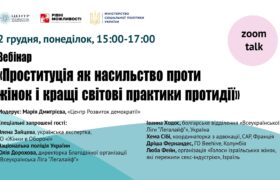
2 грудня 15:00 – онлайн-семінар “Проституція як насильство проти дівчат та жінок, кращі світові практики протидії”, присвячений обговоренню проституції як форми гендерного насильства, спрямований на аналіз глобальних практик і пошук рішень для України. Експертки розповідатимуть про досвід впровадження ефективних підходів до протидії та підтримки постраждалих.

5 грудня 15:00 – онлайн-семінар «Порнографія: небезпека для українських жінок і дітей», експлуатації жінок та дітей у порнографії та небезпеки порнографії та поза нею, загрози, пов’язані з доступом дітей до порнографічного контенту. Захід спрямований на пошук ефективних рішень для захисту постраждалих і попередження цих загроз.

6 грудня 15:00 – онлайн-семінар “Молодіжні адвокаційні кампанії з протидії насильству. Реалізація Резолюцій РБ ООН “Жінки, Мир, Безпека” та “Молодь, мир, безпека». Молодь з різних міст та сіл України розповідатимуть свої історії боротьби з насильством на рівні громад та родин.

9 грудня 15:00 – онлайн-семінар “Сурогатне материнство як загроза правам людини”, зосереджений на аналізі морально-етичних аспектів сурогатного материнства. Учасниці обговорюватимуть зв’язок сурогатного виношування з торгівлею людьми та репродуктивною експлуатацією жінок, а також його вплив на права дітей. Захід спрямований на вивчення цих викликів та пошук рішень.

ПОПЕРЕДНЯ РЕЄСТРАЦІЯ НА ЗАХОДИ є ОБОВ’ЯЗКОВОЮ (ЦЯ ФОРМА ЄДИНА ДЛЯ ВСІХ ЗАХОДІВ)

Посилання на реєстрацію

NGOs alternative statement regarding the B+30 progress implementation in the region UNECE

Referring to the Resolution adopted by the General Assembly on 23 February 2023 # ES-11/6. Principles of the Charter of the United Nations underlying a comprehensive, just, and lasting peace in Ukraine and United Nations General Assembly Resolution 68/262 adopted on 27 March 2014 by the sixty-eighth session of the United Nations General Assembly in response to the Russian annexation of Crimea and entitled “territorial integrity of Ukraine.”

Referring to the stated point in the UNSCR 1325 that peace and stability are the preconditions for implementing the Women’s Peace and Security Agenda (UNSC res/1325-2000).

The NGOs from Ukraine and other countries of the UNECE region made this statement as follow of the Beijing+30 Regional Review Meeting, titled “Reviewing 30 years of Beijing Commitments to Accelerate Gender Equality in the UNECE Region,” on October 21-22, 2024, in Geneva, Switzerland.

We must underline that the UNECE region has been suffering from wars since 2008 (Georgia), 2014 – ongoing Russian aggression against Ukraine, war affects Lebanon and Syria. All these actions caused massive ways of refugees to the European countries and increased the political power of the radical voices calling for the limitation of human rights in host countries. The hybrid wars affect the rights of women in many countries of the region. Examples of their effect are the limitation of activities of the CSOs (adoption of the law on foreign agents in Kyrgyzstan and the Government’s force to do this in Georgia, which will limit the work of the women’s CSOs), political violence against women candidates (brutal propaganda campaigns against President of Moldova Maria Sandu who support the integration of Moldova to the EU, which necessitates reforms to ensure  the high level of access to justice and human rights protection). 

The above-mentioned examples demonstrate the creation of barriers for women to participate in civil society and political processes, and women’s organizations struggle to find resources. This remains the case despite ample evidence existing that women’s participation contributes to more robust democracies and longer-lasting peace, as stated in the UNSCR 1325 and BPfA (Section E).

Russia employs human torture in illegal detention, cruel, inhuman, and degrading treatment, summary and arbitrary executions, and disappearances of children. The country’s aggressor kidnapped twenty thousand Ukrainian children, human rights activists and journalists are especially vulnerable to arbitrary detentions. Thirty Ukrainian journalists are still in Russian prisons, and seven women journalists were killed doing their professional jobs, like Victoria Amelina, who documented CRSV, and Victoria Roschyna, who was tortured in illegal Russian captivity. 

We must deplore the dire human rights and humanitarian consequences of the aggression by the Russian Federation against Ukraine, including the continuous attacks against critical infrastructure across Ukraine with devastating consequences for civilians, and express grave concern at the high number of civilian casualties, including women and children, the number of internally displaced persons and refugees in need of humanitarian assistance, and violations and abuses committed against children. The attacks on the energy system of Ukraine and the occupation of the Chornobyl and Zaporizhzhya nuclear stations are severe threats to nuclear insecurity in the European region. In its 2016 Preliminary Examination Report, the International Criminal Court reported sexual and gender-based crimes committed against civilian men and women in the temporarily occupied territories of Ukraine. As of September 2024, the Office of the General Prosecutor of Ukraine has investigated 342 CRSV cases committed by Russian combatants.  

Russian occupation of Crimea has affected the rights of the indigenous people of Crimea, Crimean Tatars. Hundreds of thousands of Crimean Tatars were forced to change their citizenship, thousands were imprisoned and suffered from xenophobia, religious intolerance in temporarily occupied Crimea, denials of economic, social and cultural rights. Women Crimean Tatars suffer from overburden of care work for their families as their husbands are in prisons as political prisoners. 

The mental and physical health of Ukrainian civilians, women, girls, elderly, and disabled people are suffering every day from missile and Shahed drone attacks. Young Ukrainians are captured in Russian captivity, like Yulia Sokolova, who was imprisoned by Russia in the occupied Ukrainian city of Skadovsk when she was 16 years old. She is a civilian girl who, according to the Geneva Conventions, could not be taken captive in Russia. She has been in a Russian prison in temporarily occupied Crimea for three years. 

The war against Ukraine has changed the women’s and feminist movement in Ukraine, but it’s not stopping it. Ukrainian women activists who try to find Activism – Work – War – Life balance are working for advocacy of women’s rights at the local, national, and global levels, defending the rights of women with disabilities, LBTQI women, and rural and Roma women and supporting them amid new challenges brought by the war.

It is impossible to start peacebuilding initiatives during the most brutal and massive war in Europe since the Second World War. Russia’s invasion of Ukraine continues to inflict a devastating toll on Ukraine and countries of the region UNECE. It is causing severe global repercussions, including terrorist movements and the adverse impact of the war on global food security, energy, nuclear security and safety, and the environment. 

The regional women’s movement must unite for international advocacy to support Ukraine and other countries suffering from the wars. 

We call on the feminists and representatives of the national gender equality machinery to act and fight for peace instead of talking about peacebuilding with aggressors.

We can’t talk about peacebuilding before the sovereignty of Ukraine is renewed according to the internationally recognized borders. Survivors of war crimes have to receive fair and long-term reparations, especially those who survived the CRSV. We urge the international community to support justice for survivors and hold Russia accountable for its crimes.

We believe that the global meeting to review progress in the implementation of the Beijing Platform for Action in March 2025 should seriously pay attention to the destruction of security in the UNECE region and human rights violations caused by the war of the Russian Federation against Ukraine. In our opinion, politically neutral language such as “conflict and geopolitical tension in the region,” which was used in the concept of the regional meeting, some speeches of participants, and the final NGO statement, does not correspond to the definition of the essence of Russia’s actions against Ukraine and UN General Assembly Resolutions underlying a comprehensive, just, and lasting peace in Ukraine. The Global meeting should pay attention to analysis of the harms and violation of women’s rights in the UNECE region and the condemnation of the corresponding actions of the aggressor country. The WPS should be mainstreamed to analysis of implementation of all Beijing Platforms chapters.

We ask the feminist movement  to not give up and advocate the governments to continue supporting Ukraine. Steadfast support for Ukraine and its victory is the best implementation of the Beijing Platform of Action and prevents wars in other countries. 

Rephrasing the Vienna Conference principle, we ask for “nothing about war-affected countries without these countries and women’s CSOs from these countries.” 

We ask to push Russia to release the Ukrainian journalists and human rights defenders, civilians from captivity and stop shelling Ukraine. 

We ask for an honest and inclusive discussion about the threats to women’s rights implementation stated above and to collaborate on developing strategies to respond to them.  

We ask to integrate the analysis of the impact of Russian aggression against Ukraine and its support of anti-democratic governments into the consolidated regional inputs for the 69th session of the Commission on the Status of Women.

Reform the UN to take effective action to stop wars, as the number of them has increased since Beijing + 25. The number of wars and their scale prove that the system doesn’t work efficiently. 

Signed NGOs representatives and number of independent gender experts and human rights, young feminist activists representatives ABC order

 Alliance Political Action for WomenUkraine
 Bila Tserkva Charitable Foundation “Zamkova Gora”Ukraine
 Board of the All-Ukrainian Public Union of WomenUkraine
 Center for women who suffered from domestic violence “Faith, Hope, Love”Ukraine
 Center of Social ServicesUkraine
 Centre for social & gender research “New Life”Ukraine
 Charity fund “Misto Tysiachi Dzherel”Ukraine
 Charity Organization FamilyUkraine
 Civic Council for the Parliamentary Gender Caucus “Equal Opportunities”Ukraine
 Civic Council of the Parliamentary Gender Caucus Equal OpportunitiesUkraine
 CO CF ThriveUkraine
 Coalition 1325 Odesa RegionUkraine
 Expert Resource Gender in DetailUkraine
 CSO “La Strada-Ukraine”Ukraine
 CSO “Heart in Palms”Ukraine
 CSO “Independent Women”Ukraine
 CSO “People with Disabilities in Future”Ukraine
 CSO “Positive Women. Odesa”Ukraine
 CSO “Positive Women”Ukraine
 CSO “Union of Multi-child families with low-income and single mothers, “Nadia”Ukraine
 CSO Center of Civic Activity SynergyUkraine
 CSO EnpudUkraine
 CSO Liberal Society InstituteUkraine
 Cultural and educational space “Honcharenko Center”Ukraine
 Democracy Development CenterUkraine
 Gender MuseumUkraine
 Women’s Informative Consulting CenterUkraine
 Health Right UkraineUkraine
 Kyiv School of Equal OpportunitiesUkraine
 National Council of Women of UkraineUkraine
 National Union of Journalists of UkraineUkraine
 New Life Charitable FoundationUkraine
 NGO “Age of Possibility”Ukraine
 NGO “Bureau of Gender Strategies and Budgeting”Ukraine
 NGO “Council of Women Farmers”Ukraine
 NGO “Culture of Democracy”Ukraine
 NGO “Open Society”Ukraine
 NGO “Special workshop — Art for autism”Ukraine
 NGO “Territory of Woman”Ukraine
 NGO “Woman of the Future”Ukraine
 NGO “Women’s Union of Solomyan District of Kyiv”Ukraine
 NGO “Culture of democracy”Ukraine
 NGO “EdCamp Ukraine”Ukraine
 NGO GIRLSUkraine
 NGO Institute of gender programsUkraine
 NGO PislyazavtraUkraine
 NGO Podilsky Center Gender Consultative CenterUkraine
 NGO Rural Women Business NetworkUkraine
 NGO Women’s Center “Support, protection and care”Ukraine
 Non-Governmental Organization “Women Association Sphere (Kharkiv)”Ukraine
 NGO “League of Professional Women”Ukraine
 Office of Support of Families of Veterans, IDPs and Combatants (Lviv)Ukraine
 Public Organization “Public Movement “Faith, Hope, Love”Ukraine
 Secretariat of the Cabinet of Ministries of UkraineUkraine
 Taras Shevchenko National University, Professor at Theory and History of Sociology DepartmentUkraine
 Ukrainian Association for Research in Women’s HistoryUkraine
 Ukrainian Heritage, Art and Music Centre – Ukrainian HAM in CambridgeUkraine
 Ukrainian Women Lawyers Association “JurFem”Ukraine
 University of Kyiv-Mohyla Academy, Department of SociologyUkraine
 Vice Chairperson NGO “Centre of Gender Culture”Ukraine
 Women in Media NGOUkraine
 Women’s Guard NGOUkraine
 Women’s Consortium of UkraineUkraine
 Women’s Information Consultative CenterUkraine

Анонс тренінгу «Лідерство як основа для захисту прав людини»

НУО “Центр – Розвиток демократії» запрошує представників та представниць груп національних меншин (спільнот), віком від 18-30 років, взяти участь у 3-денному тренінгу за темою «Лідерство як основа для захисту прав людини». Тренінг організовується та проводиться в рамках реалізації проєкту Ради Європи  «Підтримка реформування законодавчої бази щодо національних меншин та зміцнення стійкості національних меншин і ромів в Україні».

Під час тренінгу учасники та учасниці ознайомляться з наступними темами:

– права жінок та чоловіків, протидія дискримінації та насильству;

– чутливість до різноманітності;

– участь молоді у процесі прийняття рішень;

– синергія міжнародних стандартів та національного законодавства для захисту прав жінок і чоловіків. Резолюції РБ ООН «Жінки, мир та безпека», «Молодь, мир та безпека».

Критерії для відбору учасників та учасниць:

– участь у роботі рад чи громадських організаціях, ініціативних групах своїх національних меншин;

– членство в соціальній мережі молоді для відстоювання прав людини;

– організація та проведення заходів для молоді за темами тренінгу;

– брати участь у процесі прийняття рішень при розробці національних, обласних місцевих програм із захисту прав людини.

Для участі в тренінгу просимо заповнити анкету (онлайн) до 10 жовтня.  https://docs.google.com/forms/d/e/1FAIpQLSdY0T_YuEpYzRXmF13FQKcswEqo57JlRlper7oD0X3KiU3Uww/viewform

Відібрані учасники та учасниці запрошуватимуться повідомленням на електронну пошту та телефоном.

Тренінг проходитиме 26-27-28 жовтня 2024 року. Адреса повідомлятиметься запрошеним учасникам та учасницям.

Запрошуємо молодь віком 13 – 18 років приєднуватися до Молодіжних клубів правосуддя у містах Болград, Буча, Львів, Кропивницький і Луцьк!

Молодіжні клуби правосуддя відкриваються в рамках нової програми «Справедливість для української молоді: розслідування та переслідування воєнних злочинів російської федерації проти українських дітей», за підтримки Відділу з правоохоронних питань (INL) Посольства США в Україні. Програму адмініструє у Болграді, Бучі, Львові, Кропивницькому та Луцьку міжнародна неприбуткова організація PH International (Project Harmony, Inc.) у партнерстві з Генеральною прокуратурою України, проектом «Прокурор громади», Національною поліцією України та українськими неурядовими організаціями «Придунайський центр громадських ініціатив» та «Центр «Розвиток демократії».

Заходи Молодіжного клубу правосуддя включатимуть:

  • ознайомлення з функціями ювенальних прокурорів і ювенальних поліцейських,
  • системою правосуддя в інтересах дітей,
  • візити до навчальних закладів, які готують майбутніх правоохоронців,
  • ознайомлення з основами розслідувань, що ведуться на основі відкритих джерел,
  • відвідування справжніх судів,
  • навчальні судові засідання,
  • молодіжні дебати про воєнні злочини і інші правові теми.

Заняття і заходи Молодіжних клубів правосуддя проводитимуться з жовтня 2024 року до листопада 2025 року приблизно 1 (один) раз на тиждень у позашкільний час. Тривалість одного заняття 2 (дві) години. Можливі перерви під час шкільних канікул.

Учасники і учасниці Молодіжного клубу правосуддя отримають унікальну можливість  підвищити свою обізність про правосуддя, верховенство права, права дитини, а також знайомитись з практичними аспектами і ситуаціями під час зустрічей з прокурорами, поліцейськими, адвокатами, суддями, ветеранами і громадськими активістами. Отримані знання і навички особливо стануть у нагоді молоді, яка вже замислюється над своєю майбутньою освітою і кар’єрою у сфері права.

 Приєднуйтесь!

 ФІНАНСОВА ПІДТРИМКА: Участь у позашкільному «Молодіжному клубі правосуддя» є безкоштовною.

ВІК: 13 – 18 років на момент зарахування.

КАНДИДАТИ НА УЧАСТЬ У ПРОГРАМІ ПОВИННІ НАДАТИ:

  • Короткий мотиваційний лист (чому кандидат бажає взяти участь у програмі).
  • Згоду батьків або опікунів на обробку персональних даних дитини (підписується всіма батьками чи законними опікунами дитини). Бланк згоди можна отримати у тренерів Молодіжних клубів правосуддя (контакти додані нижче)
  • Посвідчення особи – паспорт або свідоцтво про народження (фотокопію).
  • 2 фотографії розміром 3 х 4 см.
  • Контактний номер телефону і електронної пошти.

 За наявності, але не обов’язково, можуть бути подані копії документів, що підтверджують складні життєві обставини дитини та/або її сім’ї. Такими документами можуть бути: довідка малозабезпеченої особи/сім’ї; акт обстеження матеріальних умов, завірений представниками органів соц. захисту або навчального закладу; посвідчення  особи/cім’ї, яка перебуває у інших складних матеріальних обставинах; документ про призначення матеріальної допомоги чи субсидії в зв’язку із складним матеріальним станом; документ про статус ВПО, учасника війни, інвалідність, багатодітної сім’ї, неповної сім’ї тощо.

 The above documents will be accepted until September 25, 2024. Candidates for participation will be interviewed, and based on the interviews’ results, successful candidates will receive invitations to attend classes by September 30, 2024.

 Зазначені документи приймаються до 25.09.2024 р. З кандидатами на участь будуть проведені співбесіди, за результатами яких успішні кандидати до 30.09.2024 р. отримають запрошення до відвідання занять.

 КОНТАКТИ:

    м. Болград (Одеська обл.), вул. Інзовська, 170, каб. 102 («Будинок офіцерів»).

Тренер: Кишлали Емма Іванівна, тел. 093-246-59-67), е-пошта: emmakyslaly6@gmail.com

Координатор: Каплієнко Микола Вікторович, e-пошта: pcgi.izmail@ukr.net

    м. Буча (Київська область), вул. Антонія Михайловського, 54, Бучанський центр позашкільної роботи ім. Андрія Куцевалова.

Тренер: Ірина Перекальська, тел. 067-830-99-68,  е-пошта: iryna467@gmail.com

Координатор: Галина Овчарова, е-пошта: Galynaovcharova@gmail.com

    м. Львів вулиця Театральна, 11, Національний університет «Львівська політехніка», Корпус 33, Інститут права, психології та інноваційної освіти,  Центр правових досліджень ґендерної рівності, Кабінет 4.

Тренер: Андрусяк Ірина Павлівна, тел. 098-119-18-65, е-пошта: Airyna2016@gmail.com

Координатор: Овчарова Галина Борисівна, е-пошта: Galynaovcharova@gmail.com

    м. Кропивницький, вул. Шульгиних, 36, Комунальний позашкілький навчальний заклад «Кіровоградський обласний центр дитячої та юнацької творчості».

Тренер: Плотніцька Ангела Олександрівна за тел. 066-179-43-60, Plo887510@gmail.com

Координатор: Овчарова Галина Борисівна, е-пошта: Galynaovcharova@gmail.com

    м. Луцьк, Проспект Президента Грушевського, 1, Луцька міська центральна бібліотека для дітей “ДіМ”.

Тренер: Богдан Лебедь, тел. 099 – 207-89-63, е-пошта: bodya.lebedb@gmail.com

Координатор: Галина Овчарова, е-пошта: Galynaovcharova@gmail.com

Приєднуйтесь!

Експертка НУО ЦРД провела в Луцьку робочу зустріч з запобігання насильству та торгівлі людьми

28 серпня 2024 року гендерна експертка НУО «Центр – Розвиток демократії» Марія Дмитрієва провела робочу зустріч з питань запобігання та протидії торгівлі людьми і домашньому насильству у м. Луцьку Волинської області. Про це повідомляється на сторінці департаменту соціальної та ветеранської політики Волинської ОДА у Facebook.

Участь у заході взяв начальник управління міграційної поліції ГУНП у Волинській області Олександр Зотько, а також голова ГО “ВЕЛЕС+” Віктор Вальчук, голова ГО  “Волинські перспективи” Ніна Пахом’юк. Під час зустрічі обговорено нові виклики та ризики в умовах воєнного стану. 

Зокрема, йшлося про такі види експлуатації жінок як сурогатне материнство, порнографія та    проституція. Розглянута шведська модель боротьби із проституцією, міжнародні правові стандарти та зарубіжний досвід протидії кримінальним правопорушенням, пов’язаним із домашнім насильством.

Раніше повідомлялося, що ЄСПЛ підтримав модель, котра криміналізує купівлю актів сексуального характеру та допомагає потерпілим від проституції.

What is the model of equality?

Ukraine

Prostitution policy: Prohibitionism – illegal

Persons in prostitution: 100.000

source

1) «Getting out of the circle of violence: the experience of prostitution survivors»

Within this event, women, who survived sexual exploitation, and social workers from different countries (Sweden, France, Canada, Ireland), which have already introduced the Equality Model, will share their experience of barriers on exiting prostitution and how social services and NGOs can help women in such situation.

2) «Equality model and law enforcement»

Within this event, police officers from different countries (Sweden, France, Canada, Israel), which have already introduced the Equality model, will share how they are working with vulnerable women and interact in this work with social services and shelters.

3) Expert discussion «Legislation and best practices to introduce the Equality Model»

Within this event, the foreign experts and parliamentarians will share their experience of working on corresponding draft laws in their countries (Sweden, France, Ireland, Canada, Latvia, the UK, Israel).

Intended audience: Ukrainian MPs, the security sector, judges, prosecutor’s office, Ministry of Social Policy, Ministry of Health Care, civil society organizations, wider public.

4) Special event for journalists “Equality Model for Ukraine: issues of coverage”

As part of this, foreign journalists will share their experience in covering the issue of sexual exploitation and information support of the Equality Model.

Intended audience: journalistic community of Ukraine, faculties of journalism of universities, intra-branch journalistic organizations of self-regulation.

youtu.be/H3JX10EDtGY

5) Expert discussion “1325 and combating conflict-related violence”

6) Expert discussion «Legislation: best practices to introduce the Equality Model»

> youtu.be/GRaI8iX8o5w

7) Competition of journalistic materials for the best coverage of the topic of the Equality Model

Starting from the first event on March 4 and until the end of April, we will accept journalistic materials for the competition.

We invite you to participate in any of these events at your convenience. The events will be held online, on the platform Zoom with recording and livestream to YouTube and Facebook. Each event is separately announced on FB and when you register you get a link to Zoom with translation.

We will also happily accept your suggestions as to experts and parliamentarians, whom we should invite to participate in these events.

The contact person and coordinator for this campaign is Democracy Development Center’s gender specialist Maria Dmytriyeva, phone / Viber / WhatsApp +38 063 100 37 51, email mdmytrieva@ddc.org.ua, who will be happy to answer all of your questions regarding this event and this campaign.

We also had the following relevant events last year (December 2020):

Sexual violence and exploitation – countermeasures facebook.com/events/371246747270606

“Women’s body is not a commodity” facebook.com/228980864124706/videos/309313676891226

Historical and legal side of prostitution in Ukraine

Not much is known about the historical context of the study of prostitution in Ukraine, because it is primarily a shadow business, so the statistics or stages of development are unidentified. It is known that in the world about 186 billion dollars are earned annually from prostitution, according to data from the European Parliament in 2014 (Sexual, 2014). Data for Ukraine vary and data on AIDS / HIV can be found more often than on the number of women involved in prostitution.

Back in 1987, prostitution was officially banned by order of the Presidium of the Verkhovna Rada of Ukraine.

The Code of Ukraine on Administrative Offenses has a separate article 181.1 – Prostitution. It states that those engaged in prostitution may receive warnings or pay a fine of 5 to 10 tax-free minimums (one tax-free minimum is equal to 17 hryvnias = 5.37 SEK) (Кодекс, 1984). This article appeared in the Code in 1987 and was supplemented later. That is, prostitution in Ukraine is subject only to the payment of an administrative fine, without criminal liability. Criminal liability for prostitution lasted from September 2001 to January 2006, and from January 12, 2006, only an administrative fine was again imposed. The pimping remained under criminal liability. And for 2020 this fine consists in payment from 85 to 170 hryvnias (26.84-53.67 SEK) and for repeated commission of an offense – from 136 to 255 hryvnias (43-80 SEK) whereas in the period from 2001 to 2006 for the same activity it was necessary to pay from 850 to 8500 hryvnias (268-2683 SEK).

Law enforcement seem to be more focused on ‘covering up’ brothels and pimps than on individual women involved into prostitution (Кива, 2020). But according to news in Ukrainian media it also happens that law enforcement or police officers blackmail and threaten women in prostitution to disclose information about them to relatives or families. For example, one of the police officers, using his official position, wanted to demand a bribe from a girl who was engaged in prostitution, so as not to reveal information about her to her family. Relatives may also threaten someone accused of prostitution, such as a father saying that he would tell everyone that his daughter had been fined prostitution if she did not leave the apartment. These are only those cases that have reached the court, but no criminal liability has been introduced for extortion. But women involved in prostitution in Ukraine could be used to expose brothels or pimps on the grounds that they will not be subject to an administrative report and their case will be rejected or closed.

There have been reports of police pretending not to noticing the existence of brothels in exchange for bribes. For example, in December 2019, police received a bribe of $ 2,000 a month for ‘covering up’ brothel owners (СБУ, 2019). Another policeman in the Odessa region demanded a bribe of $ 1,400 for hiding a brothel, for which he was detained (Поліцейський, 2019). But there are facts of detention, such as in October 2019, a brothel was exposed in Kyiv, which employed about 20 women and the pimp had an income of 70-100 thousand hryvnia per day (На Київщині, 2019). Such cases are usually difficult to detect, as they have a network of contacts and their own accountants, security guards, taxi drivers, etc.

Download

> Master Thesis Kateryna Krasnikova, 2020 – Media discourse of legalization of prostitution in Ukraine: intersectional analysis

Democracy Talks: the Swedish Model on Sex Trade Legislation

Streamed live on May 4, 2020

Countering sexual exploitation: presenting the benefits of the Swedish model

On Sep 25, 2019, a roundtable on the Nordic model of combating trafficking in human beings and prostitution was held in Kyiv, Ukraine. More than thirty representatives of state authorities and NGOs were present at the round table, broadcasting and recording provided by UKRINFORM, a state information and news agency of Ukraine.

The video is available here (in Ukrainian).

The experts explained the risks of legalization/ full decriminalization of prostitution and benefits of demand criminalization in the sex industry.

Deputy Ambassador of Sweden to Ukraine Louise Morsing stated that with the adoption of the Nordic model, fewer and fewer Swedes consider prostitution a normal behaviour. “The Nordic model is an effective counteraction to the sex industry, sexual exploitation and trafficking in human beings” she said.

According to Ms. Morsing, the law was the result of the Swedish government’s action against gender-based violence. She noted that prostitution cannot be a job, it is always exploitation and it is incompatible with internationally accepted human rights principles.

“It has been concluded that prostitution is the violence of men against women, especially against those who are economically or otherwise marginalized. This law comes from the basis of gender equality. Legally, the need to pass this law was justified by the fact that allowing men to buy women’s sex is a manifestation of gender inequality. In doing so, prostitution was acknowledged as one of the many tools used by men to oppress women and girls. In Sweden, it was concluded that it was impossible to combat human trafficking for sexual exploitation without doing anything with prostitution. Thanks to the Nordic model, we have almost no organized crime that deals with trafficking in human beings for the purpose of sexual exploitation,” Ms. Morsing said.

In turn, Yulia Dorokhova, director of the All-Ukrainian NGO “League Legalife”, believes that the official number of people involved in the sex industry in Ukraine is over 100,000, because there are too many people who do not consider themselves prostitutes, however, provide such services. She stressed that people involved in the sex industry were not aware of the benefits of a particular model of combating prostitution. Ms. Dorokhova believes that prostitution is a multigender problem. “It’s not just women and men, it’s transgender people” she said. According to Yulia Dorokhova, the main problem in the sex industry is violence. “The violence comes not only from whom they provide services, but also from the police, the state. People are not provided with medical services. The context of violence is politics of the state, traditions, religion, customs,” she noted.

Lawyer and representative of the women’s initiative Resistanta Olena Zaytseva reported that prostitution was already decriminalized in Ukraine in 2006, and now there is only administrative liability for prostitution and criminal punishment for pimping and human trafficking. Ms. Zaytseva focused attention on international and national legislation, resolutions of the European Parliament and Council of Europe. “Legalizing and decriminalizing prostitution legitimizes brothels and pimping, normalizes prostitution and the purchase of sex, and puts women and girls into higher risk of violence. Instead, the Nordic model aims to assist and rehabilitate women in prostitution, fights demand, and is a tool in the hands of the police to protect women’s rights”. The expert noted that the Council of Europe recommends the Nordic model and the European parliament does not consider decriminalisation of the sex industry a solution to keeping vulnerable women and under-age females safe from violence and exploitation. In addition, according to Ms. Zaytseva Ukraine has international commitments to address the demand in the sex industry but state does not fights demand only works with victims. Ms. Zaytseva added that one of the requirements of Ukraine’s accession to NATO will eventually be acceptance of the zero-tolerance policy regarding trafficking in human beings.

“90% of prostituted people are women. Among prostitution consumers, men make up 99%. To me, as a feminist, it’s about women’s rights,” said Maria Dmytriyeva, the moderator of Feminism UA FB group. “However, It is important to remember that this is a closed area where it is extremely difficult to conduct research”, Ms. Dmytriyeva pointed out. She noted that the average age at which girls are involved into prostitution is 14 years and the average life expectancy of women involved in prostitution is 35 years. The average number of those who have been sexually or physically abused in childhood or adolescence among women involved in prostitution is from 70% to 90%. According to Ms. Dmytriyeva, the Nordic model is more profitable for the economy than the legalization of prostitution. “The experience of those countries where prostitution was legalized shows that the social costs of prostitution are higher than any profits. Rehabilitating women and children who are still rescued from prostitution, increase in crime, treatment of diseases women contract from husbands who went to a brothel and “used” girls without a condom – the total cost for the society with legalized prostitution is far exceeding all potential profits,” the activist said.

Co-founder of YurFem, a well-known human rights activist Larysa Denysenko noted that the level of suicide attempts is highest among people involved in the sex industry. According to her, the most important thing in the topic is the inadmissibility of moral and physical traumatization of people: “We need to tell the state that the matter here is not in taxes, not in the growth of the economy, in the money laundering, not in the fight against corruption. We know what happens when they trade in the forest – it has a lot of impact on the environment. We should think about the impact of trafficking, who are the victims?”

To sign an appeal for support for the introduction of the Nordic model in Ukraine, please visit: docs.google.com/forms/d/e/1FAIpQLScAVt-ZyjQugBZegSP2HheYFQteHpriZzLFzgW_MxaaJJKsFg/viewform

Information about the Nordic model is here (mostly in Ukrainian): sites.google.com/view/nordicmodelua/

Історичне рішення: ЄСПЛ підтримав модель протидії попиту на проституцію – криміналізацію покупців

Європейський суд з прав людини виніс знакове рішення, підтримавши модель, котра криміналізує купівлю актів сексуального характеру та допомагає потерпілим від проституції. Про це йдеться у пресрелізі від European Network of Migrant Women (ENoMW), оприлюдненому 25 липня 2024 року в Брюселі, повідомляє Nordic Mоdel UA у Фейсбук.

Раніше повідомлялося, що українські громадські діячки включно з головою НУО «Центр – Розвиток демократії» Еллою Ламах долучилися до адвокаційних заходів у Франції та Німеччині для підтримки даного рішення ЄСПЛ.

«Європейська мережа жінок-мігранток (ENoMW) відзначає знакове рішення Європейського суду з прав людини у справі M.A. та інші проти Франції. Це рішення підтримує французьку модель аболіціонізму, яка криміналізує купівлю актів сексуального характеру і надає підтримку потерпілим від проституції», – йдеться у пресрелізі.

У рішенні визначено, що модель протидії попиту:

  • Пропонує важливу підтримку… для тих, хто бере участь у програмах виходу з проституції (жінок-мігранток близько 83% в проституції у Франції);
  • Призвела до збільшення розслідувань випадків сутенерства на 54% (з 2015 р.) та подвоєння кількості зупинених борделів, плюс збільшення випадків притягнення до відповідальності за торгівлю людьми на 66%;
  • Запроваджує широку систему захисту, визнаючи потерпілих від проституції вразливою групою та криміналізуючи покупців актів сексуального характеру… що позитивно впливає, зокрема на захист неповнолітніх від проституції.

Рішення базується на таких важливих віхах, як Резолюція Європейського парламенту 2023 року, яка визнає проституцію формою насильства щодо жінок і дівчат, і звіт Спеціальної доповідачки ООН з питань насильства щодо жінок і дівчат, його причин і наслідків 2024 року, в якому висвітлюються порушення прав людини, притаманні проституції та виступає за аболіціоністський підхід (криміналізацію користувачів проституції).

Європейська мережа жінок-мігранток закликає всі держави, які отримують прибуток від проституції, визнати, що вони не на тій стороні. Ці держави повинні підтримувати основні права та гідність жінок і дівчат, вносячи зміни до свого законодавства та забезпечуючи надійний захист потерпілих. Настав час діяти, щоб забезпечити майбутнє без експлуатації та насильства.

Рішення Європейського суду з прав людини знімає дамоклів меч, що висить над головами незліченної кількості вразливих жінок і дівчат в проституції. Це зміцнює захист і підтримку, яких вони вкрай потребують, забезпечуючи захист їхніх прав і гідності через аболіціоністський підхід.

«Дякуємо усім, хто долучились до того, щоб це рішення стало реальністю! Нагадаємо, що українська ГО “Центр “Розвиток демократії” на прохання CAP International – Coalition for the Abolition of Prostitution у листопаді 2023 року взяла участь у кампанії за прийняття такого рішення, і експертки організації виступили перед представниками влади у Франції та Німеччині, а також взяли участь у акції перед ЄСПЛ.

Вітаємо усіх небайдужих з цим доленосним рішенням. Тепер абсурдні заяви, що підхід протидії “порушує права” вразливих груп отримали спростування на рівні ЄСПЛ – міжнародного судового органу, юрисдикція якого поширюється на всі держави-члени Ради Європи, що ратифікували Конвенцію про захист прав людини і основоположних свобод», – йдеться у повідомленні Nordic Mоdel UA.

Нагадаємо, що Елла Ламах взяла участь в адвокаційній зустрічі з депутатами Бундестага. Також українки були присутні на марші феміністок у Парижі, в акції протесту у Страсбурзі (Франція); відбулася їхня зустріч із французькими політиками, зокрема, з представником парламенту та заступницею мера Парижа.